

Research:WikiLove

Key Personnel[edit]
- Dario Taraborelli, WMF
- Howie Fung, WMF
- Jonathan T. Morgan, University of Washington and WMF Summer of Research fellow
- Yusuke Matsubara, University of Tokyo and WMF Summer of Research fellow
Original Project Plan Summary[edit]
WikiLove is a simple experiment in appreciation. It makes it easy to send messages of praise and appreciation to other users. The tool was first built by Wikimedia Foundation developer and Wikimedian Ryan Kaldari as a small gadget, and the new editor engagement team at the Wikimedia Foundation developed it into a full feature. The analysis of this feature will focus on the following questions:
- Who sends Wikilove to whom (e.g., within or across wiki-generations, within or across edit activity classes)?
- What kind of messages are exchanged via WikiLove?
- Are new users who receive Wikilove more likely to be retained than those who don’t?
- Does the use of Wikilove affect other kinds of user contributions (e.g., editing, reverting, communicating via talk pages)?
Data[edit]
Real-time WikiLove data is currently available under an open license via the Toolserver. (Note: The toolserver is no longer online, has been replaced by tools.wmflabs.org. I don't see the data on the toollab. This section needs an update. -Pete F (talk) 18:28, 22 May 2016 (UTC))
There is also a WikiLove dashboard for English Wikipedia.
Summary of results[edit]
The following results from an analysis of WikiLove date from <date> to <date>.
Self-directed vs. real messages[edit]
Since the launch of the feature on the English Wikipedia, a consistent proportion of WikiLove messages (39% on average as of September 2011) have been sent by users to themselves, mostly for testing purposes. 61% of WikiLove messages are sent to other users.
-
 Daily proportion of real vs. self-directed WikiLove
 -
 Daily volume of real vs. self-directed WikiLove


WikiLove senders and receivers[edit]
WikiLove is being used across editor cohorts and classes of user activity.[when?] 74% of all WikiLove messages (excluding self-love) were exchanged among Wikipedians with more than 100 edits. However, the distribution of edit counts and registration years suggests that WikiLove senders are "younger" than WikiLove receivers. More than half of WikiLove messages were sent by users who registered an account in 2011 and the median edit count of WikiLove senders (486) is smaller than the median edit count of WikiLove receivers (2740).
-
 Categories of users giving WikiLove
 -
 WikiLove receivers by cohort (year of registration)
 -
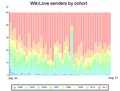 WikiLove senders by cohort (year of registration)
 -
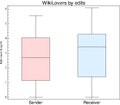 Distribution of edit counts of WIkiLove senders and receivers




Content analysis[edit]
- More details: Research:Classifying wikilove messages
A qualitative analysis of 1500+ Wikilove messages (excluding self-love and blank messages) conducted by Jonathan T. Morgan and Yusuke Matsubara in August 2011 via Mechanical Turk suggests that by far the most common type of message was "Praise/Thanks" (77%). 22% of the messages were "Other", a catch-all category that is meant to include a variety of 'off-label' uses of Wikilove (see table below for examples). "Criticism/insult" messages were a very small (<1%). Messages in the "other" category span a broad range of types: welcome messages, help requests, help response/advice, support/ spontaneous WikiLove (other than praise or gratitude), apology/reconciliation, conversational messages, notifications and (in a small number of cases) spam or advertisement.
| Message Category stats | counts | percentage |
| praise/thanks | 1198 | 77% |
| other | 347 | 22% |
| criticism/insult | 11 | <1% |
| contains word "test"?* | 20 | <2% |
| total coded messages | 1556 |
Yusuke Matsubara also developed a classifier that was trained on 2380 hand-coded messages and tested on 594 messages resulting in classification of these messages in the above categories with a high precision/recall.