
PhilWiki Community/Diversity


| Main page | By-Laws | Membership | Meetups | Facilities | Advocacy | Diversity | Education | GLAM | Outreach |
| PhilWiki Community Philippine Wikimedia Community, Inc. Philippine Wikimedia Community User Group | |
|---|---|
| |
.svg) Philippines | |
| Location |  Philippines Philippines |
| Country code | PH-WC |
| Founding date | 1 June 2015 |
| Approval date | 17 October 2015 |
| Official language(s) | Philippine languages |
| Other language(s) | Central Bikol language, Rinconada Bikol language |
| Reports | Link to reports |
| Facebook group and Facebook page | |
As a free, open and vibrant organization of Filipino volunteers and content editors from the Philippines and all over the world, the community aims to engage diverse participation in projects, programs and activities that promote free, responsibly open-content resources and reference materials through cost-effective, creative and innovative projects and partnerships with libraries, museums among others.
Maria Glenda G. Perico is the Chair of Diversity Committee (2023-present). Her first participation in the Wikimedia Movement was during the WikiGap Campaign in March 2020. Since then, she actively participates in various activities of PhilWiki Community. Marvin Molin used to head the committee. He joined Wiki Takes Rinconada in 2015 and has been involved in Wikimedia Movement since then. He represented the user group at the 2019 ESEAP Wikimedia Strategy Summit held in Bangkok, Thailand.
WikiGap Campaign in the Philippines
[edit]The Philippines has joined every edition of WikiGap Campaign in 2019. The global campaign focuses on improving and creating new articles on LGBTQ and Women related topics thru the Translation Tool. Junior and senior high school teachers have attended the activities in Naga City, Philippines held during the celebration of women's month with the goal to close the gender gap on the internet.
In 2020, five participants improved at least 30 articles each during the campaign launch and they actively worked to improve the visibility of women in seven Philippine languages namely: Bikol, Cebuano, Ilocano, Kapampangan, Pangasinan, Tagalog, and Waray. As a result, two of our participants have made it to the top contributors in the WikiGap Challenge international. PhilWiki Community had partnership with Developh Community on the 1-hour WikiGAP: Closing the Digital Gender Gap discussion via livestream during the launch WikiGap Campaign Philippines in 2021.
-
 Mind the Gap barnstar
 -
 Event attendees
 -
 Maffeth tutors a WikiGap participant


-
 Tutorial
 -
 Groupie
 -
 WikiGap PH 2023


WikiWomen
[edit]PhilWiki Community maintains a gender diverse board, which has also elected the organization's first female president. Wiki Loves Philippines project lead Maffeth C. Opiana became the first female head of the organization with Architect Ian Kenneth L. Orasa as the new board chair, who replaced Zyra B. Hila, the second female board chair elected since the formation of the community on June 1, 2015. The remaining members of the board are senior high school teacher-Wikimedians Marife G. Altabano (treasurer) and Francis Charles D. Brioso, who are both serving their second term, and WikiGap Philippines 2023 project lead and senior high school teacher Maria Glenda P. Brioso (secretary). Bikol Wikipedia administrator Joseph V. Ciudadano is the new internal auditor.
Last 20-22 October 2022, PH-WC president Maffeth Opiana attended the WikiWomenCamp 2023 in New Delhi, India. The conference with the theme "Map Up, Rise Up" brought together individuals who identify themselves as women from different countries of the Wikimedia movement. She was part of the communications team composed of Wikimedians of different backgrounds.
-
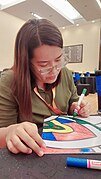 Maffeth
 -
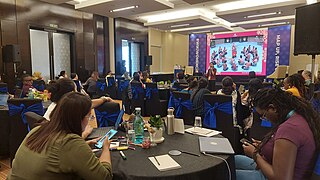 Plenary session
 -
 WikiWomen Camp 2023
.jpg)
.jpg)

ESEAP Regional Cooperation
[edit]The East, South East Asia and the Pacific or ESEAP is among the most under represented communities in the Wikimedia Movement. The ESEAP Conference brings participants from various ESEAP communities together to achieve better understanding of each community. It also aims to connect people of the Wikimedia movement within ESEAP regions, to share ideas, and to build regional collaborations
The Philippines is one of the world’s most linguistically diverse countries, with over 190 documented languages. However, only Tagalog (officially called ‘Filipino’) and English are recognized as the country’s official languages. As a result, many of these regional languages are experiencing a decline in use and there is often a shortage of written material.
In 2018, Maffeth Opiana and Irvin Sto. Tomas represented the PhilWiki Community at the inaugural ESEAP Wikimedia Conference 2018 held in Bali, Indonesia. Froy Beraña and Marvin Molin participated at the Wikimedia ESEAP Strategy Summit 2019 in Bangkok, Thailand. The conference aimed to bring ESEAP voices to the global conversation on Movement Strategy. Community leaders discussed the most relevant strategy topics for the region across thematic areas and the Wikimedia movement’s future.
-
 Irvin during his presentation
 -
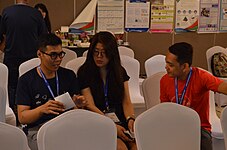 One of the sessions
 -
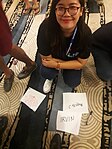 Closing ceremony
 -
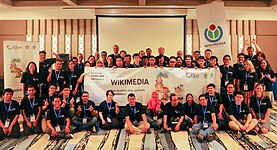 Group photo


-
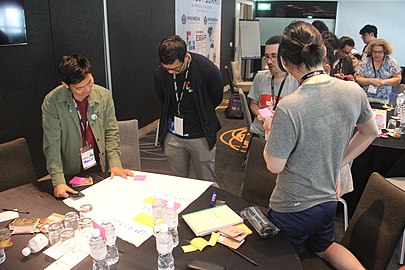 Break-out session
 -
 Conversations
 -
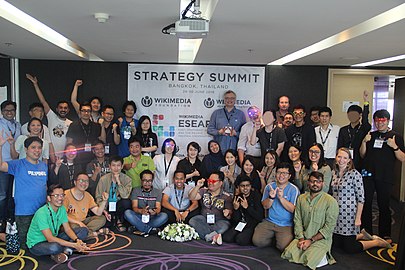 Group photo


Wikipedia Asian Month
[edit]Wikipedia Asian Month is an annual online event that occurs in November and which aims to promote Asian content on Wikipedia. PhilWiki Community has been promoting the campaign since 2015 by running the Bulan kan Asya nin Wikipedia, a local online Wikipedia activity promoting the creation or improvement of the Wikipedia content about Asia except the Philippines.
In 2021, Wikipedia Philippine Month was introduced by the Community as a monthly online event inspired by Wikipedia Asian Month which aims to promote Philippine content in Philippine Wikipedia editions and beyond. It also promotes the creation or improvement of the Wikipedia content about a particular group or groups of people in the Philippines and the region they represent. The monthly activity aims the collaboration among Filipino contributors within the archipelago and in the diaspora and create linkages among Filipino and non-Filipino contributors who support the main objective.
-
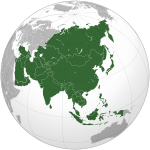 Asia
Asia -
 Bulan kan Asya nin Wikipedia
 -
 Bulan kan Asya nin Wikipedia logo
 -
 Wikipedia Philippine Monthly online edit-a-thon
.svg)


Lingua Libre Philippines
[edit]Lingua Libre Philippines is a future project of PhilWiki Community which aims to collect audios of the vocabulary of different Philippine languages. The Philippines is one of the world’s most linguistically diverse countries, with over 190 documented languages. However, under the 1987 Constitution, only Tagalog (officially called ‘Filipino’) and English are recognized as the country’s official languages. As a result, many of these regional languages are experiencing a decline in use and there is often a shortage of written material. Documentation of the vocabulary of different Philippine languages is the main goal of the project.
Philippine Wikimedia Community User Group activities | |||||||||||||
|---|---|---|---|---|---|---|---|---|---|---|---|---|---|
| Meetups |
| | |||||||||||
| Photo Contests |
| ||||||||||||
| Other Contests |
| ||||||||||||
| Member's Individual Grants |
| ||||||||||||
| User Group Grants |
| ||||||||||||
| Withdrawn Member's and User Group Grants |
| ||||||||||||
| Initiatives (Self-funded) | |||||||||||||